
A Shed, a Rig and a Daily BTC Figure
A garden shed can host a mining rig, but it cannot negotiate with the electricity grid. At 86 TH/s, current conditions produce 3.858e-05 BTC a day, worth $3.27 at $84,692 per BTC, or $3.14 after the listed 4% on the block-reward component. The daily figure is easy to calculate; the shed's wiring and airflow are what decide whether it arrives every day.

Key takeaways
- At 86 TH/s, daily output is 3.858e-05 BTC, or $3.27 gross and $3.14 net of the listed 4% on the block-reward component.
- At 860 TH/s the same inputs give 0.00038584 BTC a day, $32.67 gross and $31.37 net.
- A shed's circuit, breaker and ventilation set the real ceiling on how many machines fit.
- PPS+ pays hourly against current difficulty; PPLNS pays after 6 confirmations across the last 5 difficulty rounds.
The shed is a power and heat decision
Most small mining setups fail on infrastructure rather than on hashrate. A shed may have a single circuit, a long cable run and no dedicated ventilation. Adding a machine that draws more than the circuit can carry is not a mining problem; it is an electrical one, and it should be solved before the rig is ordered. The daily BTC figure assumes the machine is running at its rated speed, which assumes the power and the airflow are adequate.
Heat is the second constraint. A shed with the door closed becomes an oven, and the firmware responds by reducing frequency. The result is a machine that is powered on but not producing the expected hash. The fix is usually a proper intake and exhaust path rather than a bigger fan, because moving air through the space is more effective than stirring it inside.
What the daily figure assumes
The daily figure comes from three network inputs: your hashrate, the network hashrate and the daily issuance. At 1,003 EH/s and 3.125 BTC per block across 144 blocks, the network issues 450 BTC a day. Your share is 86 divided by 1,003,000,000, and that share times 450 BTC is the gross. The BTC price converts the result into dollars.
The ViaBTC Bitcoin Mining account applies the payout method. PPS+ settles hourly against current difficulty with a listed 4% on the block-reward component and a listed 2% on transaction fees. PPLNS combines both and carries a listed 2%, paying after 6 confirmations. For a shed-sized operation, the method matters less than the uptime, because a machine that is offline earns nothing under either schedule.
Three sizes for one shed
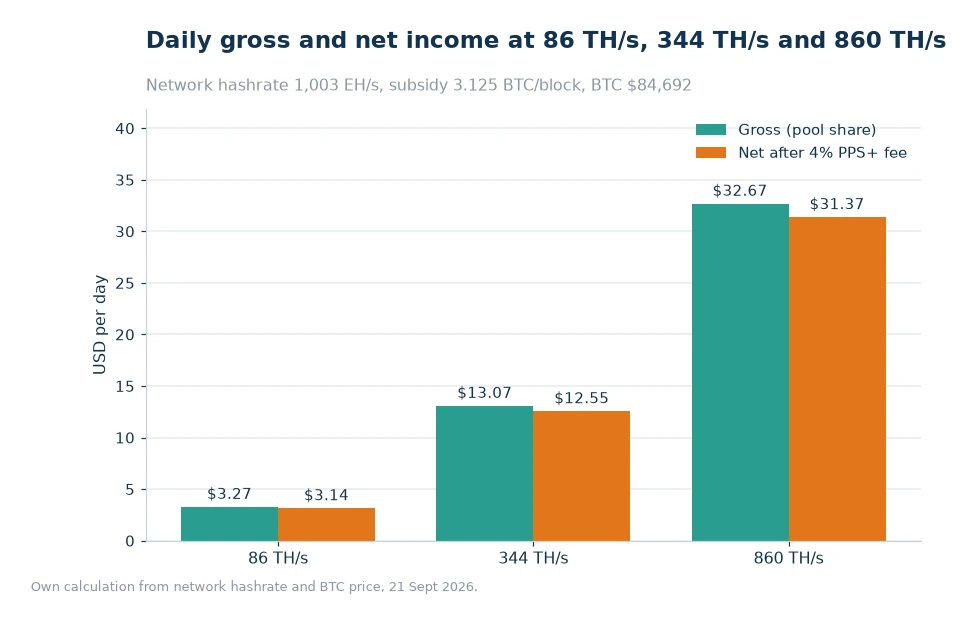
The rows below step from one machine to four and then to ten. The net column applies the listed 4% to the block-reward component and excludes the shed's power draw, which is the cost the meter actually measures. A shed that cannot carry the top row's power should stay at the middle row, even if the payout table looks more attractive at the top.
| Hashrate | BTC per day | Gross USD per day | Net USD per day |
|---|---|---|---|
| 86 TH/s | 0.00003858 | $3.27 | $3.14 |
| 344 TH/s | 0.00015434 | $13.07 | $12.55 |
| 860 TH/s | 0.00038584 | $32.67 | $31.37 |
At the first row, a month of net income is about $94.20 before power. That is enough to cover a modest electricity bill and not much more, which is why the shed's cost structure matters. The top row is ten machines, and its monthly net is about $941.10 before power, but it also needs ten times the circuit capacity and a much larger exhaust path. The table shows the reward; the shed shows the constraint.
Ventilation without overbuilding
A useful rule is to separate intake from exhaust so the air crosses the machines rather than circulating around them. A sealed shed with one fan and one vent will move some heat, but it will also pull dust and moisture across the boards. A filtered intake and a dedicated exhaust path cost more at installation and save maintenance later, especially in a space that was not designed for continuous heat.
Cooling power is part of the daily cost, so overbuilding has a price too. The aim is the smallest airflow that keeps the reported hashrate at the rated figure through the hottest part of the day. Measure the reported hashrate at midday, not at midnight, and compare it with the nameplate. That single check tells you whether the ventilation is adequate without guessing from the temperature outside.
The winter and summer spread
A shed's cooling load changes with the seasons, and so does the power bill. In a cold month the exhaust may be enough on its own; in a hot month an additional fan or a small air conditioner may be needed. That seasonal spread should be built into the monthly budget rather than discovered in July. The daily BTC figure does not change with the weather, but the net after power does.
The next difficulty estimate is minus 2.12%, which would raise output per terahash slightly if it holds. That is a small help in any season and not a substitute for adequate airflow. Treat the difficulty estimate as a minor adjustment to the revenue line, and treat the seasonal power change as a major adjustment to the cost line. The second is larger and entirely within the operator's control.
Worked example
Take 86 TH/s and run the chart arithmetic with the inputs read on 21 Sept 2026.
- Daily BTC per TH/s is 450 divided by 1,003,000,000, which equals 4.4865e-07.
- Multiply by 86: 4.4865e-07 times 86 equals 3.8584e-05 BTC, shown as 3.858e-05.
- Multiply by the BTC price: 3.8584e-05 times $84,692 equals $3.27 gross.
- Apply the listed 4% to the block-reward component: 4% of $3.27 is $0.13, leaving $3.14 net.
- Multiply by four for 344 TH/s: 0.00015434 BTC, $13.07 gross and $12.55 net.
- Multiply by ten for 860 TH/s: 0.00038584 BTC, $32.67 gross and $31.37 net.
- Thirty days at 86 TH/s nets about $94.20 before power, which is the figure the shed's meter has to leave room for.
Keep the payout and the parts list together
A multi-currency wallet in the same account as the mining dashboard makes it easy to see the daily credit and the balance without moving between tools. For a shed operation, that simplicity is worth more than a long feature list, because the person checking the rig is often the same person who pays the power bill.
Write the daily gross, the listed charge, the power cost and the net on one sheet. At 86 TH/s the gross is $3.27 and the net is $3.14 before power. If the meter leaves a positive remainder through the hottest month, the shed is doing its job. If not, the next dollar is better spent on airflow or a better circuit than on another machine.
Frequently asked questions
Can a garden shed power an 86 TH/s rig?
It can if the circuit, breaker and cable are rated for the machine's draw and the airflow keeps it at rated speed. The hashrate does not decide that; an electrician and a thermometer do.
Does the listed pool fee depend on where the rig sits?
No. The listed 4% on the block-reward component and the listed 2% on transaction fees apply under PPS+ regardless of location, and PPLNS carries a listed 2% on both components combined.
Why does the daily figure not change with the seasons?
The coin figure depends on network hashrate and difficulty, not on weather. The dollar net after power does change with the seasons, because cooling and heating alter the meter reading while the payout stays on its own schedule.
Check the circuit before the next machine
Add up the draw of every machine on the circuit, then add the fans and the lights. Compare the total with the breaker rating and leave headroom for a startup surge. At 86 TH/s the daily net is $3.14 before power, and a circuit upgrade can cost more than a month of that figure. Do the electrical sum first, then the mining sum, and the shed stays a workshop rather than a hazard.
Sources: the ViaBTC homepage for the pool setup and the fee schedule for the listed 4% and 2% rates. Network hashrate 1,003 EH/s, difficulty 132.76 T, subsidy 3.125 BTC per block, 450 BTC daily and BTC $84,692 were read 21 Sept 2026, published 22 Oct 2026[1]. Every dollar figure is arithmetic on those inputs and moves when they move.